Which All-in-One Marketing Platform Is Right for Your Business?
Choosing an all-in-one marketing platform often comes down to how a business manages leads, automation, and customer relationships.
HubSpot and GoHighLevel are two well-known platforms that approach marketing automation and CRM from very different angles. While both are considered “all-in-one,” they are designed for distinct use cases and business models.
This comparison breaks down HubSpot vs GoHighLevel across features, AI capabilities, usability, pricing structure, and ideal use cases—without assuming one platform is right for everyone.
Overview: HubSpot vs GoHighLevel
At a high level, the main difference between HubSpot and GoHighLevel lies in who they are built for.
-
HubSpot focuses on structured marketing, CRM, and long-term business growth.
-
GoHighLevel prioritizes automation, lead workflows, and multi-client operations.
Understanding this distinction is key before comparing features in detail.
Core Platform Focus
HubSpot
HubSpot is designed as a CRM-first platform that integrates marketing, sales, customer service, and content management into a unified ecosystem.
Its primary focus areas include:
-
Marketing automation and analytics
-
CRM-based customer journeys
-
Content and inbound marketing
-
Long-term scalability for growing teams
HubSpot emphasizes structure, reporting, and consistency across departments.
Core Platform Focus
HubSpot
HubSpot is designed as a CRM-first platform that integrates marketing, sales, customer service, and content management into a unified ecosystem.
Its primary focus areas include:
-
Marketing automation and analytics
-
CRM-based customer journeys
-
Content and inbound marketing
-
Long-term scalability for growing teams
HubSpot emphasizes structure, reporting, and consistency across departments.

Marketing Automation & Workflows
HubSpot Automation
HubSpot’s automation is structured around lifecycle stages and customer journeys.
Common use cases:
-
Email nurturing campaigns
-
Lead scoring and segmentation
-
Automated follow-ups based on behavior
-
Analytics-driven workflow optimization
Automation in HubSpot is closely tied to reporting and long-term strategy.
GoHighLevel Automation
GoHighLevel approaches automation from an execution-first perspective.
Typical workflows include:
-
Immediate lead follow-ups
-
Appointment reminders
-
SMS and email sequences
-
Internal notifications for teams
Automation is one of GoHighLevel’s strongest features, especially for businesses handling high lead volumes.
AI Capabilities Comparison
HubSpot AI
HubSpot’s AI features focus on improving productivity and insights, including:
-
AI-assisted content drafts
-
Predictive lead scoring
-
Campaign performance insights
-
Workflow optimization suggestions
AI in HubSpot supports decision-making rather than replacing strategy.
AI Capabilities Comparison
HubSpot AI
HubSpot’s AI features focus on improving productivity and insights, including:
-
AI-assisted content drafts
-
Predictive lead scoring
-
Campaign performance insights
-
Workflow optimization suggestions
AI in HubSpot supports decision-making rather than replacing strategy.

Ease of Use & Onboarding
HubSpot
HubSpot provides a structured onboarding experience supported by:
-
Extensive documentation
-
Guided setup
-
Learning resources and certifications
However, advanced features may require time to master.
GoHighLevel
GoHighLevel offers flexibility but with a steeper learning curve:
-
Highly customizable workflows
-
Less guided onboarding
-
Requires planning before setup
It is better suited for users who already understand automation logic.
Pricing Structure (High-Level Comparison)
HubSpot Pricing
-
Free CRM available
-
Tiered plans (Starter, Professional, Enterprise)
-
Costs increase with features and contact volume
HubSpot pricing scales as businesses grow.
GoHighLevel Pricing
-
Subscription-based plans
-
Agency-focused tiers
-
Pricing designed for automation-heavy usage
GoHighLevel pricing favors businesses managing multiple clients or workflows.
Integrations & Ecosystem
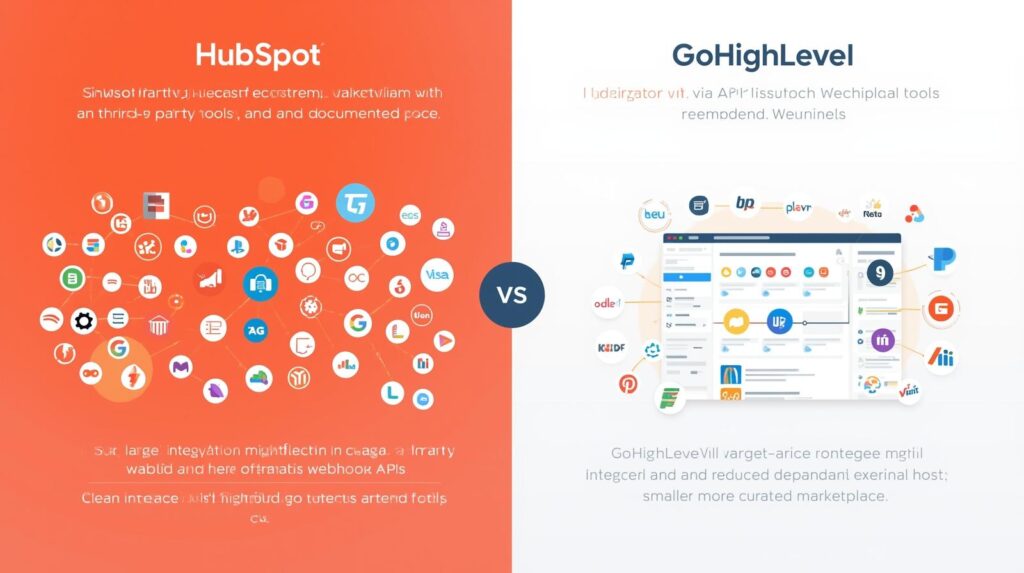
HubSpot
-
Large integration marketplace
-
Strong ecosystem of third-party tools
-
Well-documented APIs
GoHighLevel
-
Integrations via APIs and webhooks
-
Focus on reducing dependency on external tools
-
Flexible but less extensive marketplace
Who Should Choose HubSpot?
HubSpot is a strong option for:
-
Growing small and mid-sized businesses
-
Content-driven marketing teams
-
Companies prioritizing analytics and reporting
-
Businesses planning long-term scalability
Who Should Choose GoHighLevel?
GoHighLevel is better suited for:
-
Marketing agencies
-
Consultants and service providers
-
Businesses focused on lead handling and automation
-
Teams managing multiple clients
HubSpot vs GoHighLevel: Key Differences at a Glance
| Area | HubSpot | GoHighLevel |
|---|---|---|
| Primary focus | CRM & inbound marketing | Automation & lead workflows |
| Best for | Growing teams | Agencies & service businesses |
| AI usage | Insights & optimization | Execution & automation |
| Learning curve | Moderate | Steeper |
| Content marketing | Strong | Limited |
Final Thoughts
HubSpot and GoHighLevel solve different problems under the “all-in-one” label.
HubSpot prioritizes structured growth, analytics, and long-term marketing strategy.
GoHighLevel focuses on execution speed, automation, and operational efficiency.
The right choice depends on how your business operates, not on feature lists alone.
Affiliate Disclosure
Some links on this page may be affiliate links. This does not affect our analysis or editorial independence.